

A guide to the practice
What is Vedic Meditation?
A simple, effortless technique for deep rest, clarity and awareness.
In short
The simplest answer.
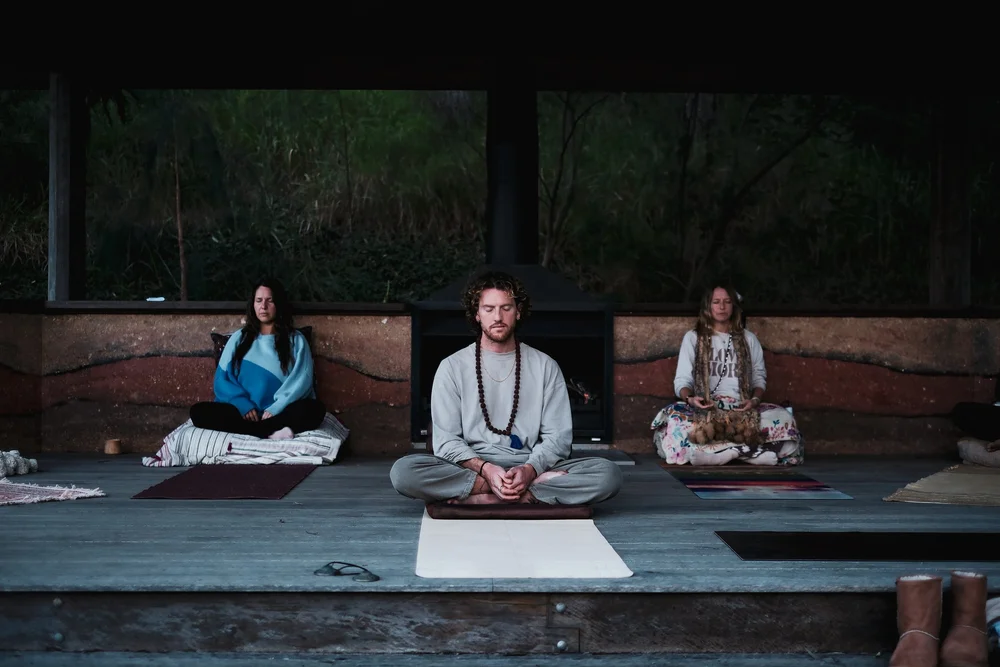
Vedic Meditation is a mantra-based technique from the ancient Vedic tradition of India. You sit comfortably with your eyes closed for 20 minutes, twice a day, and silently use a personal mantra that lets the mind settle effortlessly into deep rest. There's no concentration, no clearing the mind and no breath control.
How it works
Let the mind settle on its own.
The mind is naturally drawn towards whatever is more charming. Vedic Meditation uses that tendency instead of fighting it. Your teacher gives you a mantra, a meaningless sound chosen for its soothing quality, and shows you how to think it with almost no effort.
As you do, the mind gradually settles to quieter and quieter levels of thinking, and the body follows. Breathing slows, the body settles, and you move into a state of deep rest that's different from sleep: the body rests deeply while the mind stays quietly awake.
Thoughts still come and go. That's part of the process, not a mistake. You don't have to stop them, judge them or focus past them. You simply come back to the mantra, easily, whenever you notice you've drifted.

Where it comes from
An ancient tradition, passed on in person.
Vedic Meditation comes from the Vedas, the ancient body of knowledge from India. Veda simply means knowledge. For thousands of years the technique has been handed from teacher to student in person, rather than written down or recorded.
In the twentieth century, Maharishi Mahesh Yogi brought this style of mantra meditation to the world. Today it's taught by independent teachers trained in the same tradition. Mike Watts trained in India under Vedic masters and is recognised within the Shankaracharya lineage as a teacher of Vedic Meditation.
How it's different
Not mindfulness. Not concentration.
Most people have tried some kind of meditation before. Here's where Vedic Meditation sits.
Mindfulness
Asks you to observe the breath, the body or your thoughts. Vedic Meditation doesn't ask you to watch anything; the mantra does the work.
Concentration
Techniques that focus the mind on one point take effort. Vedic Meditation is effortless by design, which is why it can feel so restful.
Guided & app meditation
Follows someone else's voice. Vedic Meditation is self-sufficient: once you've learnt, you need nothing but a chair and 20 minutes.
Transcendental Meditation
A very close relative with the same roots. See how they compare.
What people notice
Rest deeply. Live fully.
Everyone's experience is their own, but these are the changes people describe most often.
Deeper sleep
Falling asleep more easily and waking more rested.
Less reactive
Stress lands more softly. There's more space between what happens and how you respond.
A clearer head
Decisions feel simpler and focus holds for longer.
More energy
Two short sits a day leave more in the tank for the rest of it.
More creativity
Ideas come more freely when the mind isn't so crowded.
More yourself
Less worried, more content, less chasing.
How to learn
Four days. For life.
Vedic Meditation is learnt over four consecutive sessions, in person. On the first day you receive your personal mantra in a one-to-one initiation. Over the next three days you learn the mechanics, why it works and how to fit it into daily life, so that by the end you're a self-sufficient meditator.
In Sydney, Mike Watts teaches the course in Bondi, with lifetime support afterwards: group meditations, check-ins and the freedom to revisit the course whenever you like.
Questions
Good to know.
How long until I notice a difference?
Most people notice something within the first week: deeper sleep, a calmer reaction to stress, a clearer head. The effects build with regular practice, twice a day.
Can I learn Vedic Meditation from an app or online?
Vedic Meditation is traditionally taught in person, one teacher to one student. You receive a personal mantra and learn how to use it correctly over four sessions, so the practice is right for you from the start and you're never left guessing.
Do I need to sit cross-legged?
No. You sit comfortably, usually in a chair or on a couch with your back supported, and close your eyes. You can practise on a train, in a park or at your desk.
Is Vedic Meditation religious?
No. You don't need to subscribe to any particular religion or belief system to practise it. The technique comes from the Vedic tradition of India. Veda means knowledge.
Is Vedic Meditation the same as Transcendental Meditation?
They share the same roots and are very similar techniques, but they're taught through different channels. Read the full comparison.
Where can I learn Vedic Meditation in Sydney?
Mike Watts teaches the four-day Learn Vedic Meditation course in person in Bondi, with ongoing support afterwards. See the next course or start with a free intro call.
Start with a conversation.
A short, no-pressure chat with Mike about where you're at and what you're looking for.